Having funded four phases the Trustees of The Tavistock Trust for Aphasia are delighted to announce that they will be funding the Collaboration of Aphasia Trialists (CATs) for a further three years from August 2026 until July 2029.
The Collaboration of Aphasia Trialist (CATs) has been funded by The Tavistock Trust for Aphasia since 2017, during which time it has grown to include more than 360 members, representing 41 countries and 43 languages. CATs has achieved a unique position in the international landscape. It is an aphasia-specialist organisation, which harmonises methodology and datasets, providing us strength and allowing us to be future focussed and values driven.
The CATs vision is to reinforce the role of CATs as a global community, creating better futures for people affected by aphasia and to support the CATs mission to inspire positive change in aphasia research and in the implementation of evidence-based approaches. CATs aims to achieve this through high-quality aphasia research, leveraging multi-national collaboration and with attention to those under-represented. This article summarises CATs achievements in the first decade.
Together the researchers are sharing: –
• An aphasia research database which is the only comprehensive dataset of assessment details and treatment outcomes in the field of aphasia
• The Trials for aphasia panel which promotes best practice in aphasia randomised controlled trials
• Best practice for the adaptation of aphasia assessment tools into non-English languages
• Resources to support access for people with aphasia into research
• Expertise with Junior and Early-Stage Researchers
• Best practice for the conduct and reporting of high-quality aphasia research.
CATs members work within the following groups, led by the Executive Committee: –
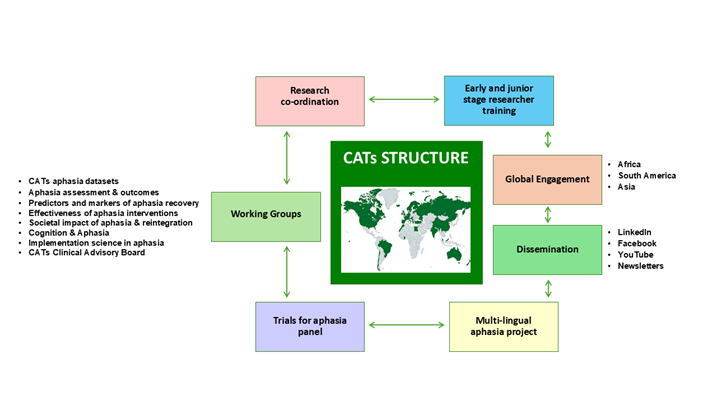
Over the next three years CATs phase 5 will continue its core commitment to researcher capacity building. Online masterclasses, training sessions, and presentation opportunities at the annual meetings are effective at supporting people’s needs. During this next period of funding, CATs will continue to emphasise implementation, impact, and influencing.
 The
The