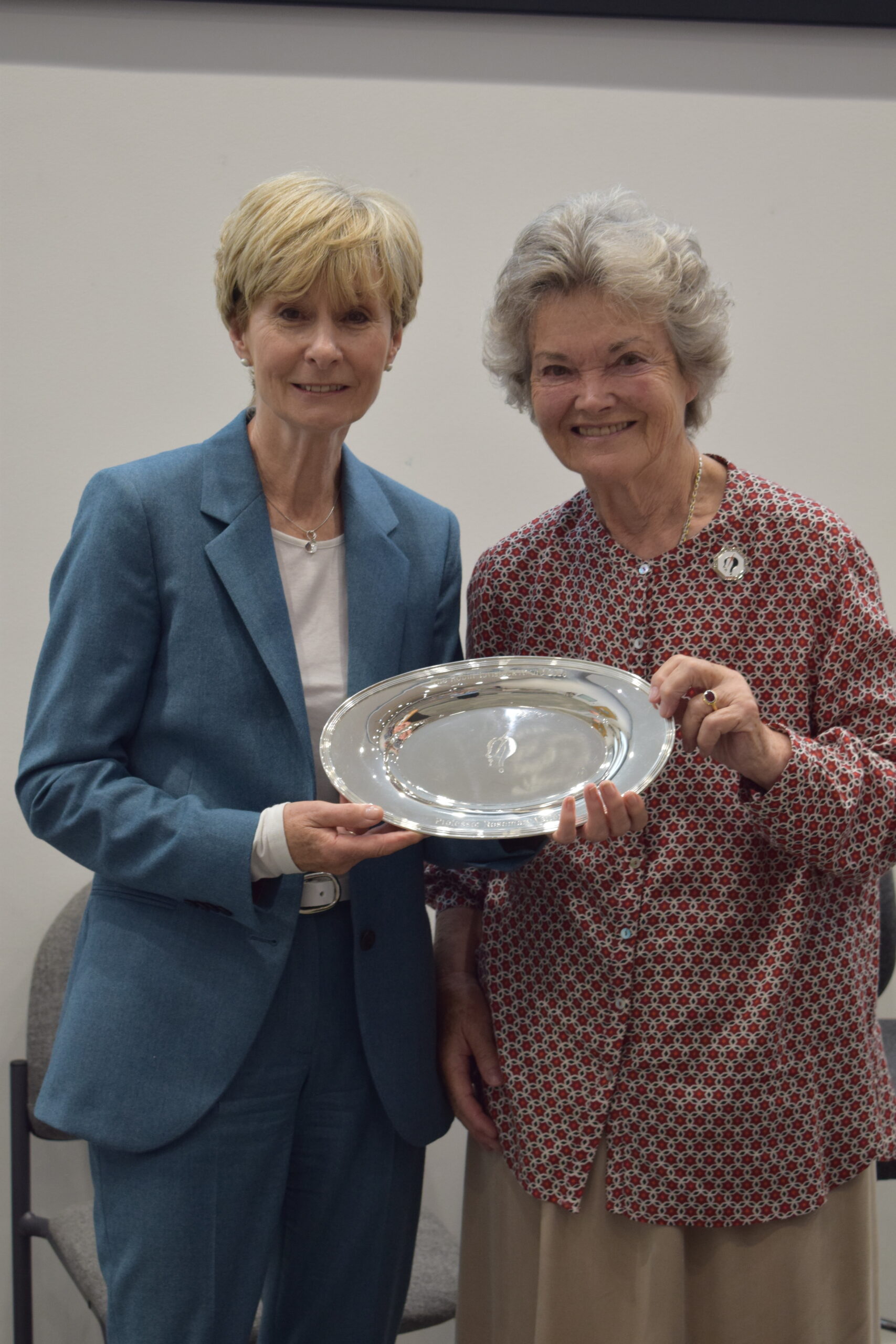
The Trustees of The Tavistock Trust for Aphasia are delighted to announce that Professor Rosemary Varley is the 2026 recipient of The Robin Tavistock Award.
This award is named after Robin Tavistock, the 14th Duke of Bedford who founded The Tavistock Trust for Aphasia. It is presented annually to a person, or group, who is inspirational and has made a significant contribution to the field of aphasia.
It is impossible in a press release to list all Professor Varley’s achievements, especially as her work covers such a broad spectrum, sitting at the intersection of cognitive neuroscience, neurorehabilitation and compassionate clinical practice. She has dedicated her career to understanding aphasia and related disorders – conditions that affect not just speech, but the very fabric of human connection. The sole focus of this Award is on her aphasia related work.
Professor Rosemary Varley has challenged long-held assumptions, opened new pathways of enquiry and, with others, has shown that the brain is far more adaptive than we once believed. As an example, we would highlight her pioneering work on the relationship between language and thought. This has not only advanced our theoretical understanding but also provided intriguing evidence of how aspects of our intellect can withstand even severe aphasia.
The Robin Tavistock Award is also in recognition of her novel and important rehabilitation research. Working from an often complex theoretical basis, she has developed practical and user-friendly therapy techniques that make a real difference to the lives of people with speech and language disorders. A prime example here was the SWORD program which was shown to improve speech production in apraxia, a disorder that commonly accompanies aphasia. This work also demonstrates her early adoption of computing technology in the rehabilitation of aphasia, and her commitment to making that technology available to the wider clinical community. We also await with excitement the findings from her current UTILISE trial.
Professor Varley’s theoretical and rehabilitation research has generated an impressive publication record, with over 140 papers and thousands of citations. But her work and its impact cannot be measured by citations alone. She has trained and mentored students, clinicians, and researchers, instilling in them not only scientific rigour but also compassion and curiosity. Both at Sheffield and UCL, Professor Varley has made a huge contribution to the teaching of speech and language therapy. We are sure that countless clinicians working today owe their inspiration to her.
Professor Varley has demonstrated, time and again, that the study of language is inseparable from the lives and voices of those who live with its loss. Critically, she ensures that the person with aphasia is at the heart of all work done on their behalf.
To colleagues, she is a collaborator who brings clarity, insight, and generosity. To her students, she is someone who encourages them to ask bold questions and pursue answers with persistence. And to the wider aphasia community, her work represents hope—that through research, empathy, and innovation, people with aphasia can improve and find new ways to face the struggle of loss of communication.
The criterion for this Award is to recognise a person or group who is inspirational and has made a significant contribution to the field of aphasia. Professor Rosemary Varley has done this and more and she is indeed a worthy recipient of The Robin Tavistock Award 2026.
If you require further information, please contact:
 The
The